
ABOUT US
Featured Projects
Hi5 SIMS: Quadrupole-based UHV SIMS with plasma FIB
Designed and built in collaboration between Oregon Physics, Hiden Analytical, and Imperial College London, the Hi5 SIMS project successfully developed a uniquely advanced ultra-high vacuum plasma FIB-SIMS instrument for 3D chemical and microstructural surface analysis. Hi5 SIMS marked the first commercial instance of simultaneous positive and negative secondary ion collection, allowing for the preservation of critical sample volume while conducting dual polarity analysis of sample material, thus cutting total analysis time in half and yielding more accurate ion chemical mapping of complex limited-quantity and/or air-sensitive materials.
Hi5 SIMS has applications in a bevy of research areas, including aerospace, energy storage and materials (solar, fuel cells, batteries), failure analysis (surface chemistry, functional coatings, defect identification), medical, metallurgy (corrosion), and nuclear.
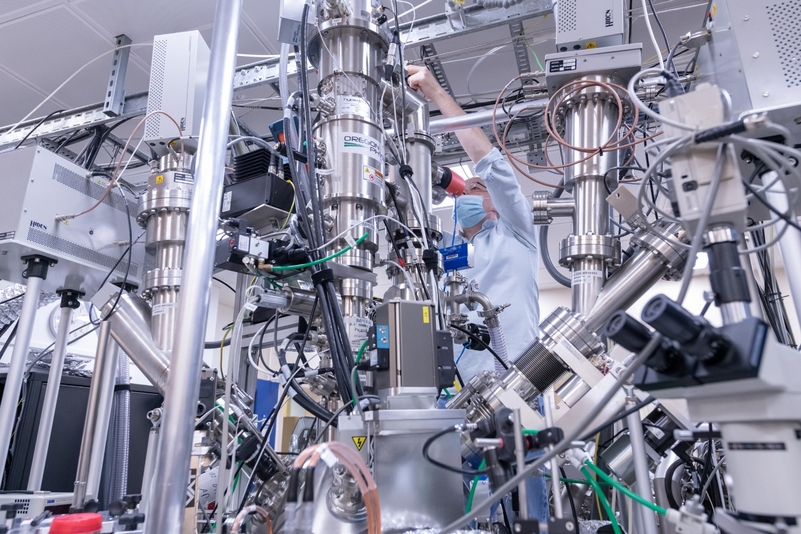
The Hi5 SIMS instrument utilizes a novel next-generation Oregon Physics Hyperion® II plasma ion source, configured to operate with positive ion extraction and equipped with an achromatic mass and neutral filter, an automated variable beam defining aperture, a gas delivery system, and beam control electronics. This Oregon Physics ion column is mounted on a Hiden Analytical UHV chamber. Hiden Analytical also supplied two quadrupole secondary ion mass spectrometers (SIMS) for the project which enable the simultaneous positive and negative ion chemical mapping functionality.
Funded by the UK national research council (EPSRC) and installed at the Imperial College London Surface Analysis Facility over an extended period (October 2018 to 2022), Hi5 SIMS offers a multitude of unique capabilities and features not found on standard UHV SIMS systems, such as:
- Simultaneous positive and negative ion detection
- A broad range of beam current (1pA to 5μA) and spot size (~25nm to 5μm at 30keV) performance with a variety of gas ions (O2+, Xe+, He+) resulting in higher sensitivity and improved lateral resolution
- Real-time in-situ/in-operando processing, analysis, and experimentation capabilities without leaving vacuum, courtesy of built-in process chambers for isotopic diffusion studies, micro-manipulation functionality for sample preparation, and the ability to heat, cool, and electrically probe samples during SIMS analysis
- Five axis stage for accurate sample positioning
- Reduced effects of mass interference due to high mass resolution quadrupole operation in the first and second stability regions