ABOUT US
History
A Brief History
The founders of Oregon Physics came together over shared interest in making advanced ion source technology accessible to more researchers. Our collaborations with equipment manufacturers have resulted in significant improvements in spatial resolution and data acquisition times for Secondary Ion Mass Spectrometry (SIMS) and Low-Energy Ion Scattering (LEIS) spectroscopy instruments.
This enhanced instrument performance has resulted in high depth resolution and high throughput SIMS viability for the semiconductor industry, as well as significant gains in SIMS and LEIS spatial resolution for scientists engaged in a broad range of activities including nuclear forensics, astrochemistry, microbiology, and surface catalyst studies.
We prioritize projects that will yield a significant impact in research or industry, and we take pride in creating high reliability, high quality, and high-performance products. This approach has led us to cultivate long term relationships with scientific researchers and instrument designers all over the world. Two of our very first customers upon our founding in 2007 have continued to work with us over the years, and have grown to become our largest customers in present day.
Oregon Physics has grown steadily from its four original employees to a staff of 30+. As a company, we work together to continue our mission: developing advanced ion and electron beam instrumentation that positively impacts scientific discovery, modern industry, and human health.
Oregon Physics Timeline
2007
Founded by Doug Kinion, Noel Martin, Noel Smith, and Paul Tesch.
2008
Presented work on a high-brightness ion source for nanoprobe SIMS applications at the 2008 International SIMS Conference.
2008
Awarded National Science Foundation (NSF) grant for the study of a Novel Ion Source for Enhanced Focused Ion Beam Material Removal at the Nano, Micro and Macro-Scales.
2008
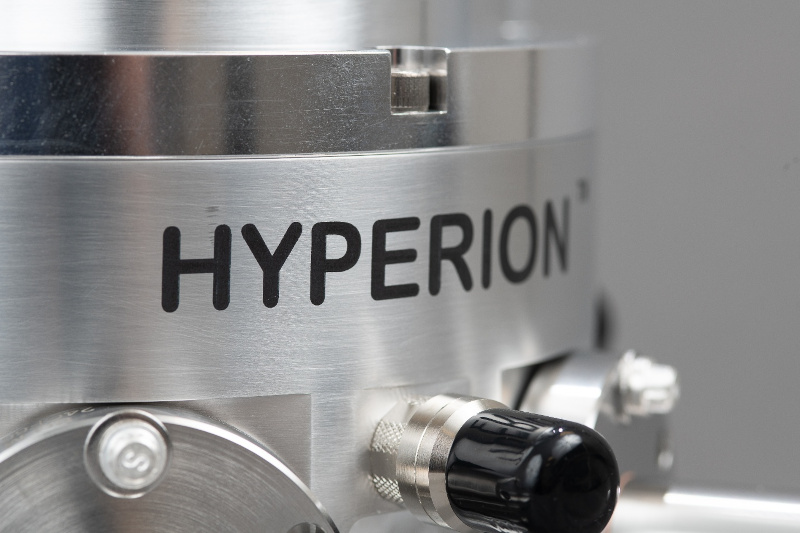
Shipped first-generation Hyperion® I standalone ion source.
2008
Presented early work on Xenon PFIB applications at the 2008 ISTFA Conference.
2008
Professor Rod Boswell of the Australian National University joins Oregon Physics.
2009
Opened the FIB Service Laboratory featuring high-current Plasma FIB (PFIB) services.
2010
Shipped first-generation Hyperion® I ion source with control electronics.
2011
Developed prototype Hyperion® negative oxygen ion source for use at Lawrence Livermore National Laboratory.
2012
Awarded NSF Phase I grant for High Brightness C60+ Ion Source for 2D and 3D Chemical Analysis in Nanobiology.
2012
Awarded Department of Energy (DoE) Phase I grant for Ultra High Brightness Plasma Ion Source for SIMS Imaging of Actinides at the Theoretical Resolution Limit.
2012
Shipped Oregon Physics’ first custom electron gun.
2012
Moved into new location at Sunset Center in Oregon’s “Silicon Forest.”
2013
Awarded DoE Phase II grant for Ultra High Brightness Plasma Ion Source for SIMS Imaging of Actinides at the Theoretical Resolution Limit.
2013
Received patent for High Voltage Isolation and Cooling for an Inductively Coupled Plasma Ion Source.
2014
Shipped first-generation Hyperion® II ion source with complete control electronics.
2015
Introduced the VRG 1 kW variable frequency RF generator for use with Oregon Physics' plasma ion sources.
2016
Shipped 50th Hyperion® ion source.
2018
Moved to a new, larger facility offering additional space for our growing operations, enabling higher-volume manufacturing capacity, and providing room for future expansion.
2019
Awarded three patents for source technology.
2019
Shipped 100th Hyperion® ion source.
2020
Noel Martin retires from Oregon Physics.
2022
Noel Smith transitions from Oregon Physics Manager to focus on research.
2023
Expanded into an adjacent office space, increasing the Oregon Physics facility size by 50%.
2024
Built a second clean room to support electron gun manufacturing, testing, and research.
2025
Acquired MIBIscope™ intellectual property and digital assets from Ionpath, including patents, trademarks, software, product designs, and documentation. MIBIscope’s™ multiplex ion beam imaging technology enables high-definition spatial proteomics in order to achieve phenotype mapping and actionable analysis of tissue microenvironments—marking a critical step forward in disease research.
2025
Awarded patent for improved gas line high voltage isolation in plasma sources.
2026
Reached a headcount of 31 employees as the company continues to grow and expand.